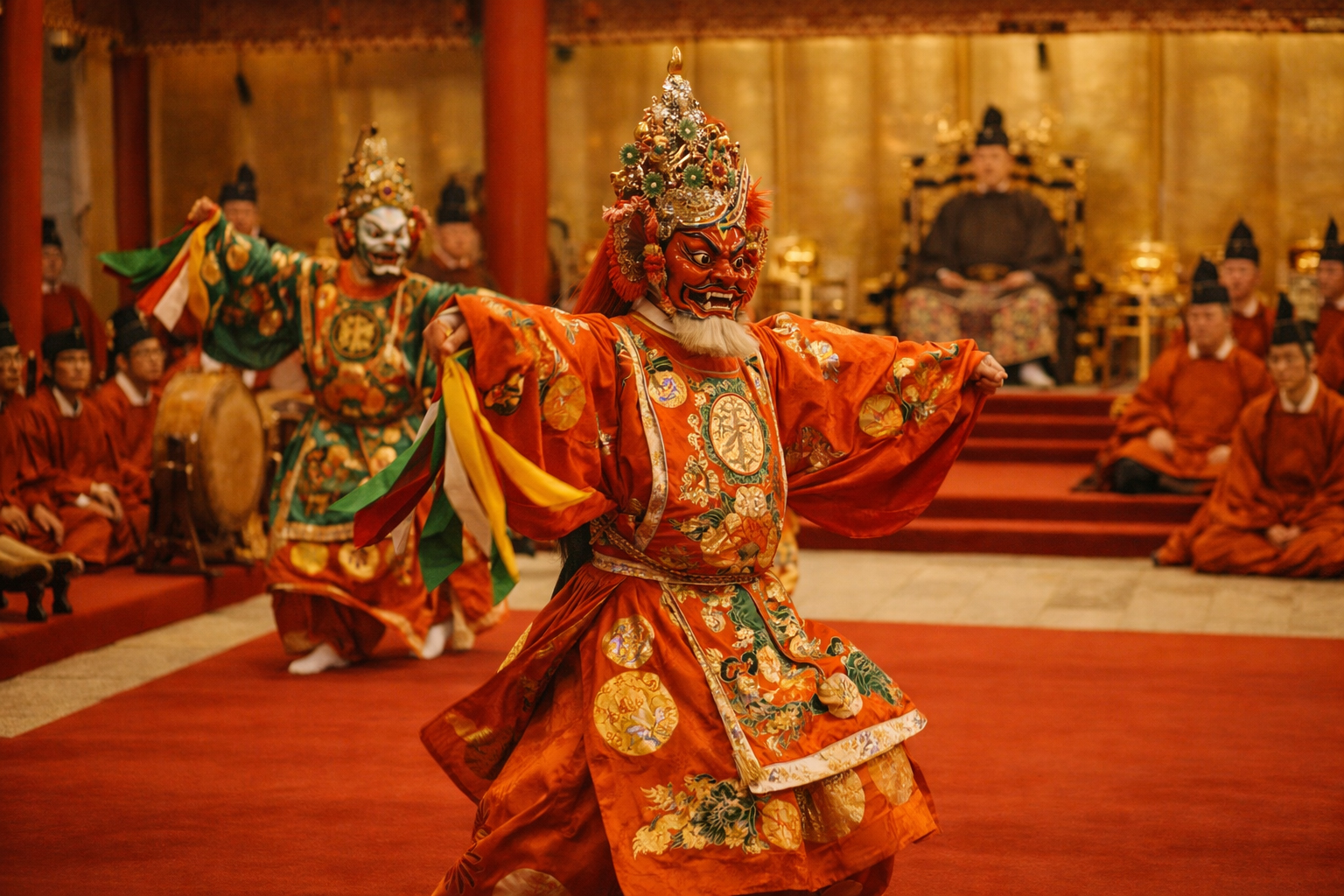
Court dance
Bugaku and the Imperial Court
Read the ordered courtly counterpart to shrine-based sacred dance.

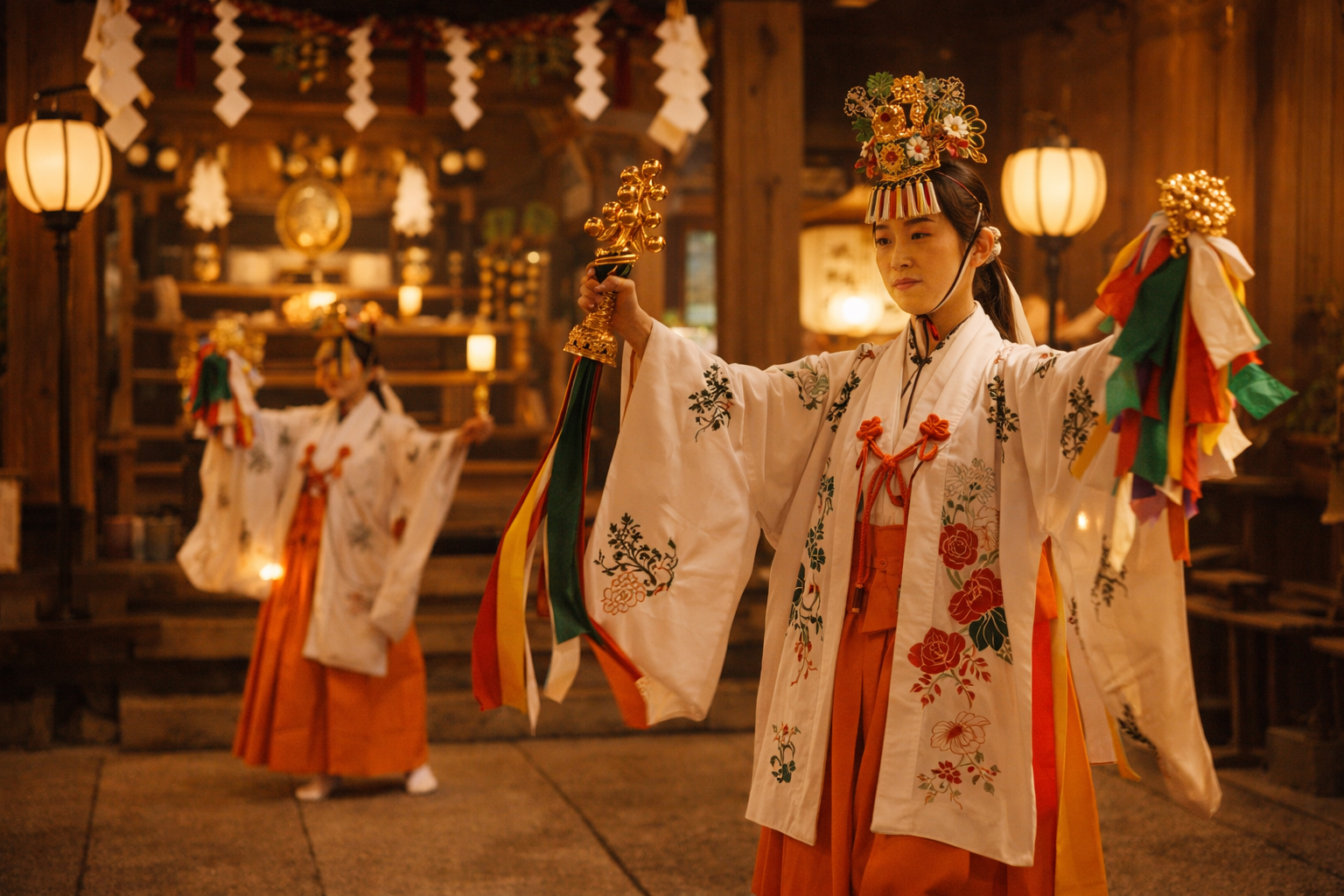
If you trace Japanese dance history back beyond city nightlife and even beyond communal festival circles, you come to movement offered to the gods. That is Kagura: sacred music and dance within Shinto ritual, performed to entertain, welcome, and calm the kami. :contentReference[oaicite:21]{index=21}
Kagura is widely understood as sacred music and dance performed at shrines. Britannica describes shrine music and dance in Shinto as intended to entertain and appease the kami rather than merely praise them. :contentReference[oaicite:22]{index=22}
That point matters because it tells us what kind of dance this is. Kagura is not first a spectacle for human audiences. It is first a ritual act that shapes the relation between sacred space, community, and divine presence. :contentReference[oaicite:23]{index=23}
Kagura began less as dance for display
than as dance for making a sacred encounter possible.
Kagura is often explained as music and dance performed to entertain the gods. Official tourism material also presents it as an ancient sacred ritual tradition rooted in Shinto. :contentReference[oaicite:24]{index=24}
In that sense, dance is not ornament added to ritual. It is one of the ritual’s core ways of bringing myth and sacred time into the present. The body becomes part of how the shrine world is made perceptible. :contentReference[oaicite:25]{index=25}
Many larger shrines include a kagura-den, a stage or hall for ceremonial dance. Britannica explicitly lists the kagura-den as one of the additional structures that may appear within shrine architecture. :contentReference[oaicite:26]{index=26}
That architectural fact is revealing. It means that sacred dance is not incidental to shrine life. In some shrine environments, movement is important enough to have its own designated space within the sacred compound. :contentReference[oaicite:27]{index=27}
Kagura is part of the structure of Shinto ritual, not merely an extra performance. :contentReference[oaicite:28]{index=28}
The kagura-den shows how deeply sacred dance can be embedded in shrine architecture. :contentReference[oaicite:29]{index=29}
Kagura preserves a very old sacred logic while remaining active in regional practice today. :contentReference[oaicite:30]{index=30}
Kagura is often linked to the myth of Amaterasu hiding in the cave. At Takachiho Shrine, visitors are told that nightly Kagura performances reenact the story in which the sun goddess withdraws and is enticed back out. :contentReference[oaicite:31]{index=31}
That mythic connection is central. Kagura is one of the ways myth is not just told but physically repeated. Sacred narrative becomes living movement. :contentReference[oaicite:32]{index=32}
Kagura is distinct both from court dance and from communal festival dance. Bugaku belongs to court ritual and ordered imperial space, while Bon Odori belongs to communal seasonal gathering. Kagura belongs above all to shrine ritual and sacred mythic space. :contentReference[oaicite:33]{index=33}
So Japanese dance history can be read through several overlapping roots: dance for the gods, dance for the court, and dance for the community. Kagura sits at the center of the first root. This is an inference drawn from the historical distinctions above. :contentReference[oaicite:34]{index=34}
Japanese dance has several deep beginnings:
sacred dance, court dance, and communal dance.
Kagura is not a single fixed format. There are many regional forms across Japan, including Shonai Kagura, Matsumae Kagura, Sato-Kagura, and Iwami Kagura, each with its own masks, rhythms, staging, and local history. :contentReference[oaicite:35]{index=35}
In one place Kagura may feel solemn and restrained. Elsewhere it may be dynamic, mask-heavy, and dramatically theatrical. That means Kagura is both sacred tradition and regional culture at once. :contentReference[oaicite:36]{index=36}
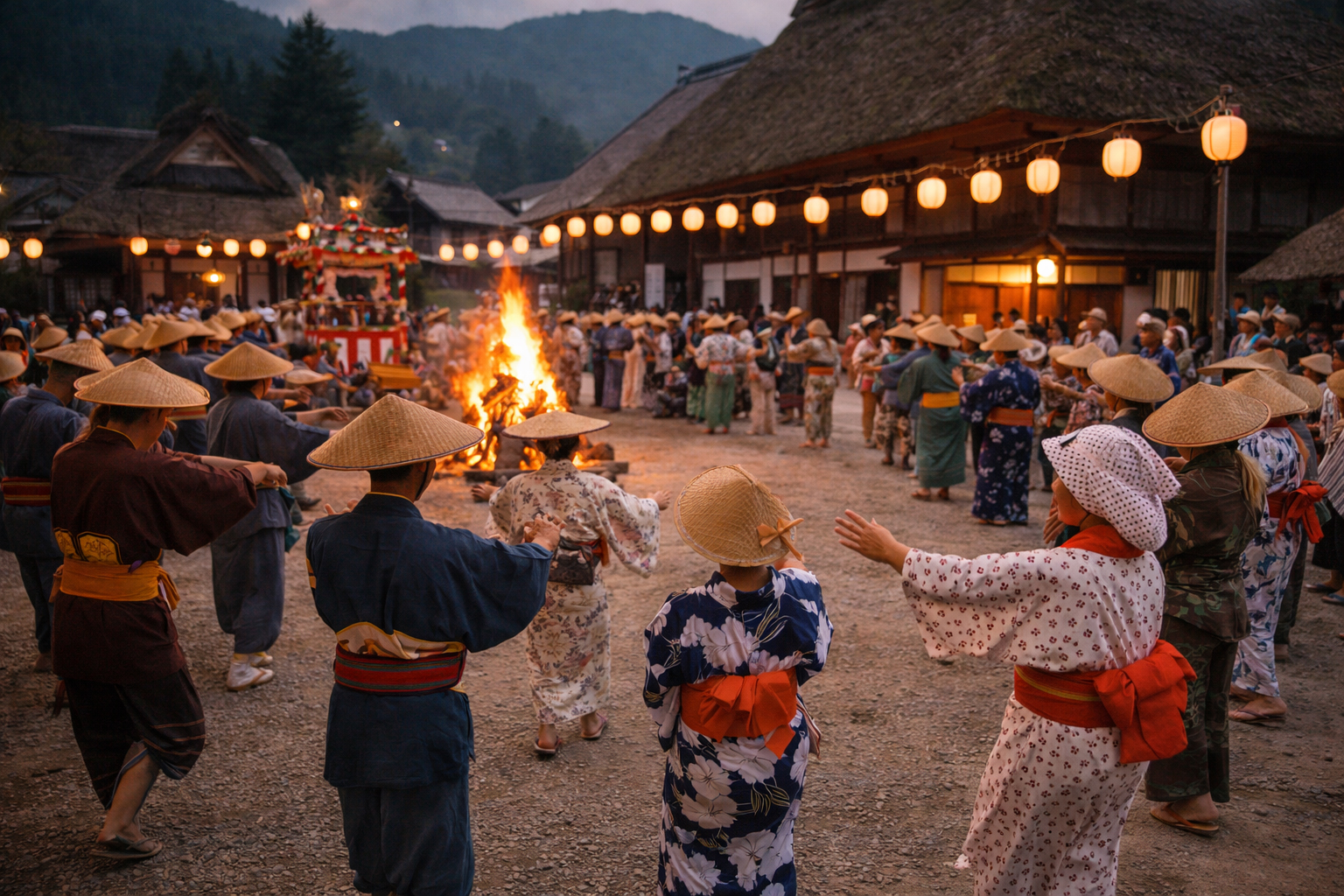
Kagura is national in principle but strongly local in actual expression. :contentReference[oaicite:37]{index=37}
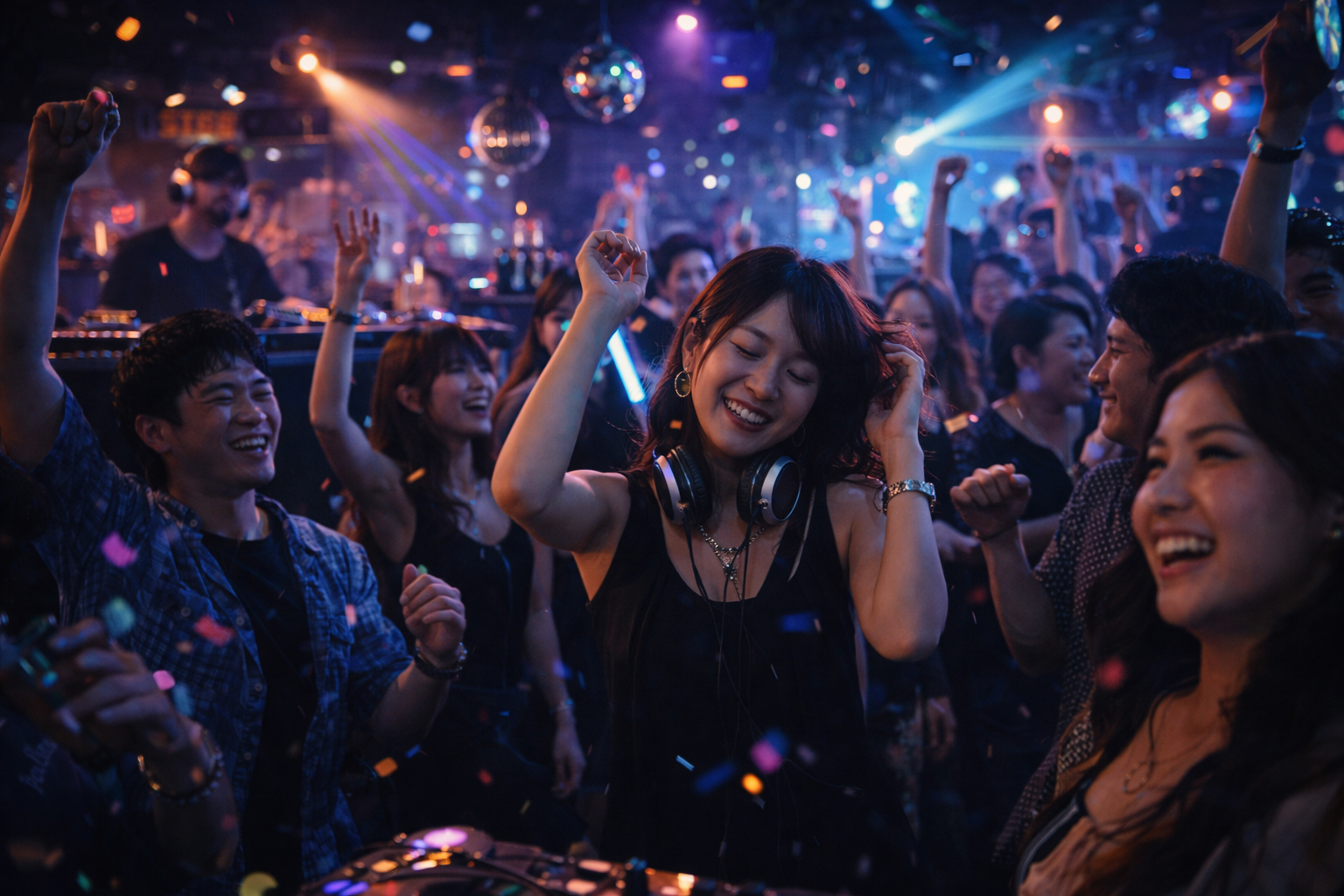
It looks remote from modern nightlife, yet it remains one of the deepest layers of meaningful movement in Japan. This is an interpretation based on the historical record above. :contentReference[oaicite:38]{index=38}
Kagura and sacred dance may feel very far from modern nightlife. But in the long history of Japanese dance, movement offered to the gods is one of the oldest and most important starting points. :contentReference[oaicite:39]{index=39}
clubs.co.jp wants to preserve Kagura not just as old religious ceremony, but as one of the great beginnings of how movement, myth, architecture, and community were bound together in Japan. This is the site’s editorial synthesis of the sources above. :contentReference[oaicite:40]{index=40}
Read the ordered courtly counterpart to shrine-based sacred dance.
Move from sacred offering to the communal circle of seasonal dance.
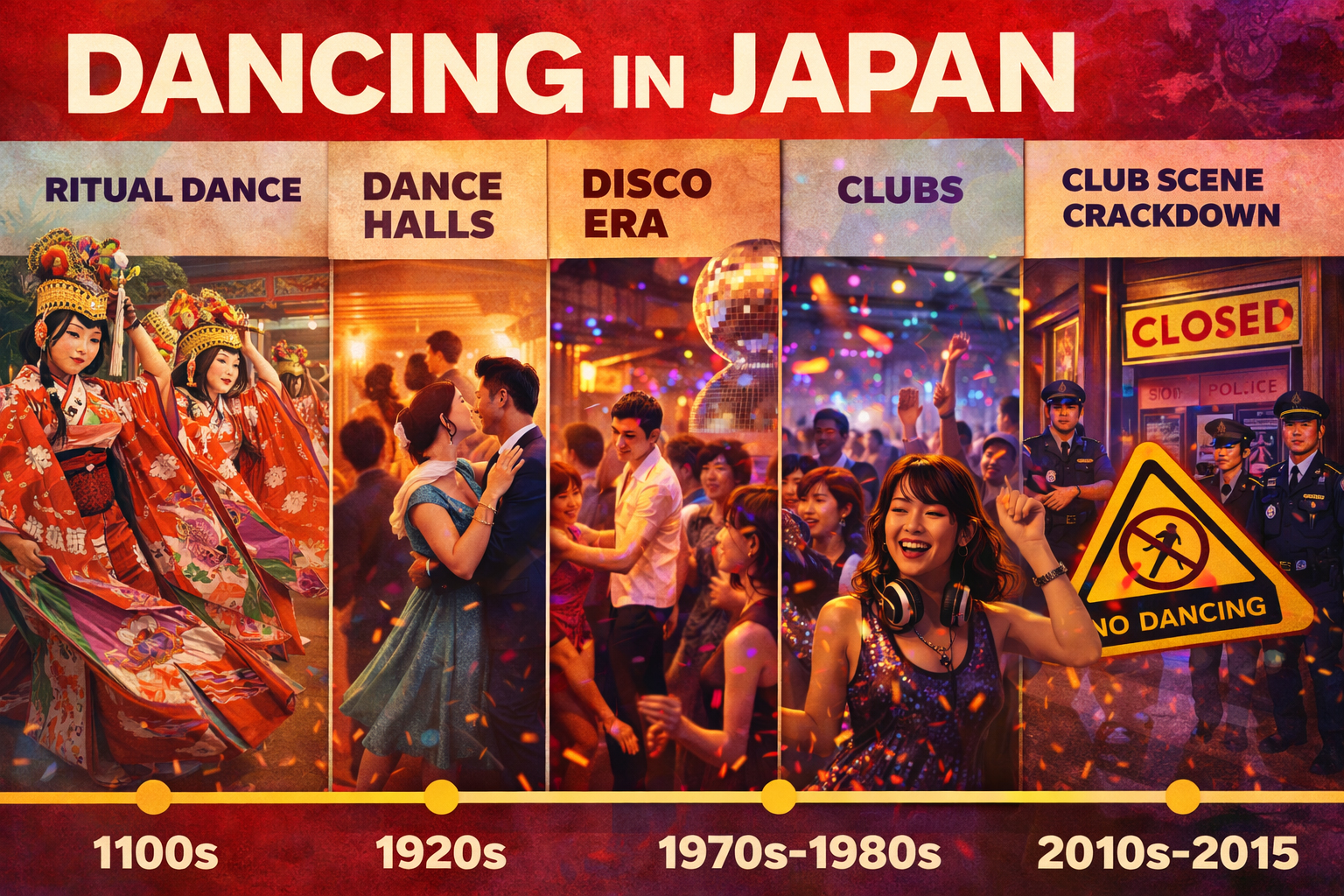
Follow the wider arc from Kagura to court dance, folk dance, cities, discos, clubs, and reform.