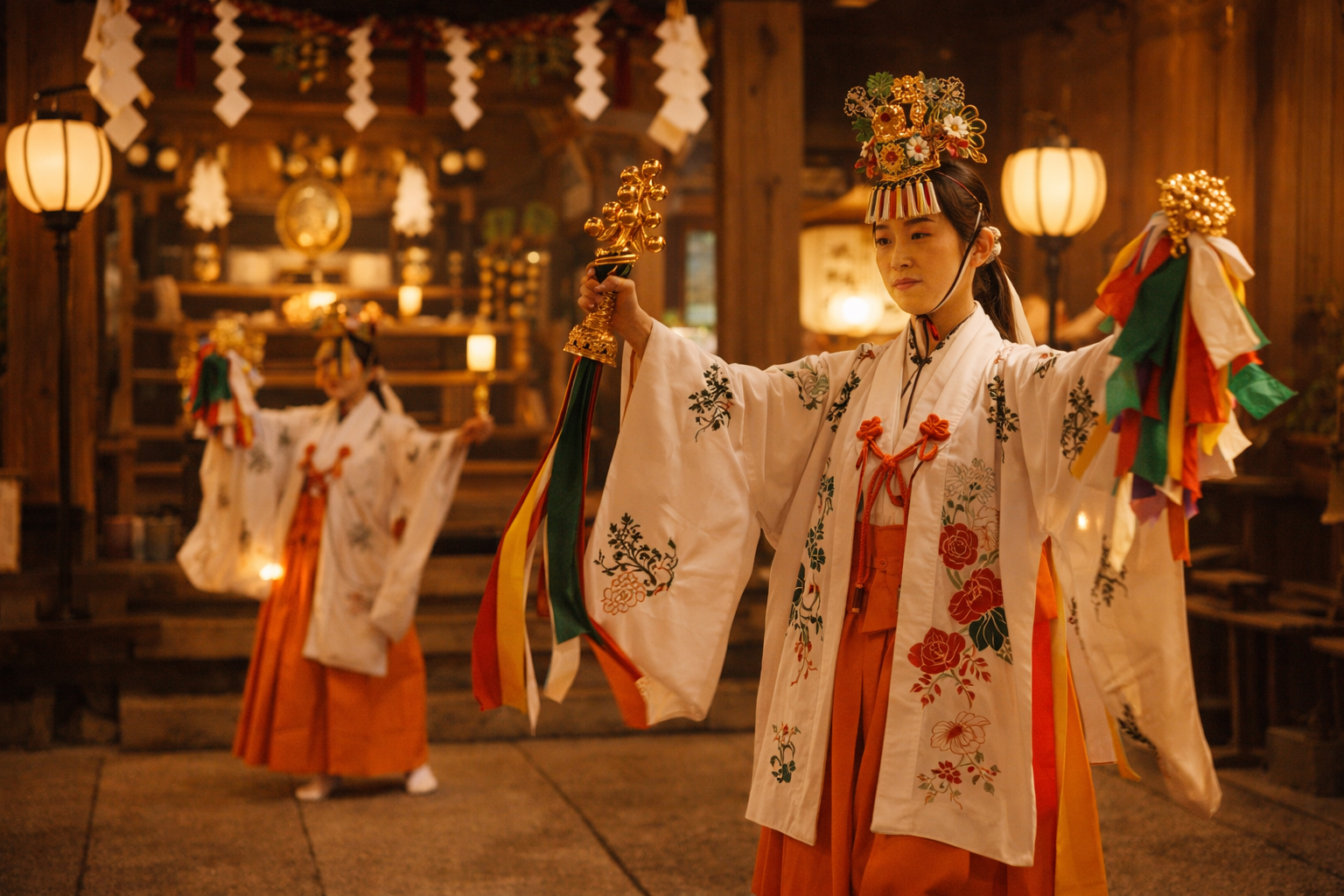
Sacred dance
Kagura and Sacred Dance
The sacred branch of ancient movement, directed toward shrine ritual and myth.

If you trace Japanese dance history far enough back, before city nightlife, before folk festival circles, and before most later stage forms, you reach movement understood as a bridge between humans and the divine. :contentReference[oaicite:13]{index=13}
Britannica explains that from prehistoric times in Japan, dance served as an intermediary between humans and the gods. That is a very large statement, and it helps define the deepest layer of the subject: dance began not first as display, but as ritual action. :contentReference[oaicite:14]{index=14}
For that reason, ancient dance in Japan is not one neat form. There is the sacred line of kagura at shrines, the later courtly formalization of bugaku, and older transmitted traditions that entered from the continent and were reorganized inside Japanese ritual and court culture. :contentReference[oaicite:15]{index=15}
Ancient Japanese dance belonged to myth and ritual
before later nightlife would belong to pleasure and self-expression.
Kagura is one of the key entrances into ancient Japanese dance. It is understood as sacred Shinto dance and is connected to the mythic reenactment of luring Amaterasu from the cave. :contentReference[oaicite:16]{index=16}
In Kagura, movement is directed first toward the gods. Even if human spectators are present, the deeper logic remains sacred rather than theatrical. The body becomes a vehicle for making myth present. :contentReference[oaicite:17]{index=17}
Ancient dance in Japan also took shape inside court culture. Bugaku is the repertoire of dances of the Japanese imperial court, derived from dance forms imported from China, Korea, India, and Southeast Asia. :contentReference[oaicite:18]{index=18}
The Imperial Household Agency explains that gagaku, including its associated dances, had reached its artistic form by about the 10th century. So by the early medieval period, ancient sacred and transmitted movements had already been organized into highly durable court form. :contentReference[oaicite:19]{index=19}
The earliest layer emphasizes mediation between humans and gods. :contentReference[oaicite:20]{index=20}
Ancient dances were later formalized inside imperial and court frameworks. :contentReference[oaicite:21]{index=21}
The story of ancient Japanese dance includes transmission and adaptation from the wider region. :contentReference[oaicite:22]{index=22}
Compared with modern nightlife dance, ancient forms look slow, formal, and directional. That slowness is meaningful. These dances are not designed first to explode emotion, but to establish order, time, and sacred or ceremonial presence.
In that sense, ancient dance is one of the first places where movement becomes culture through form.
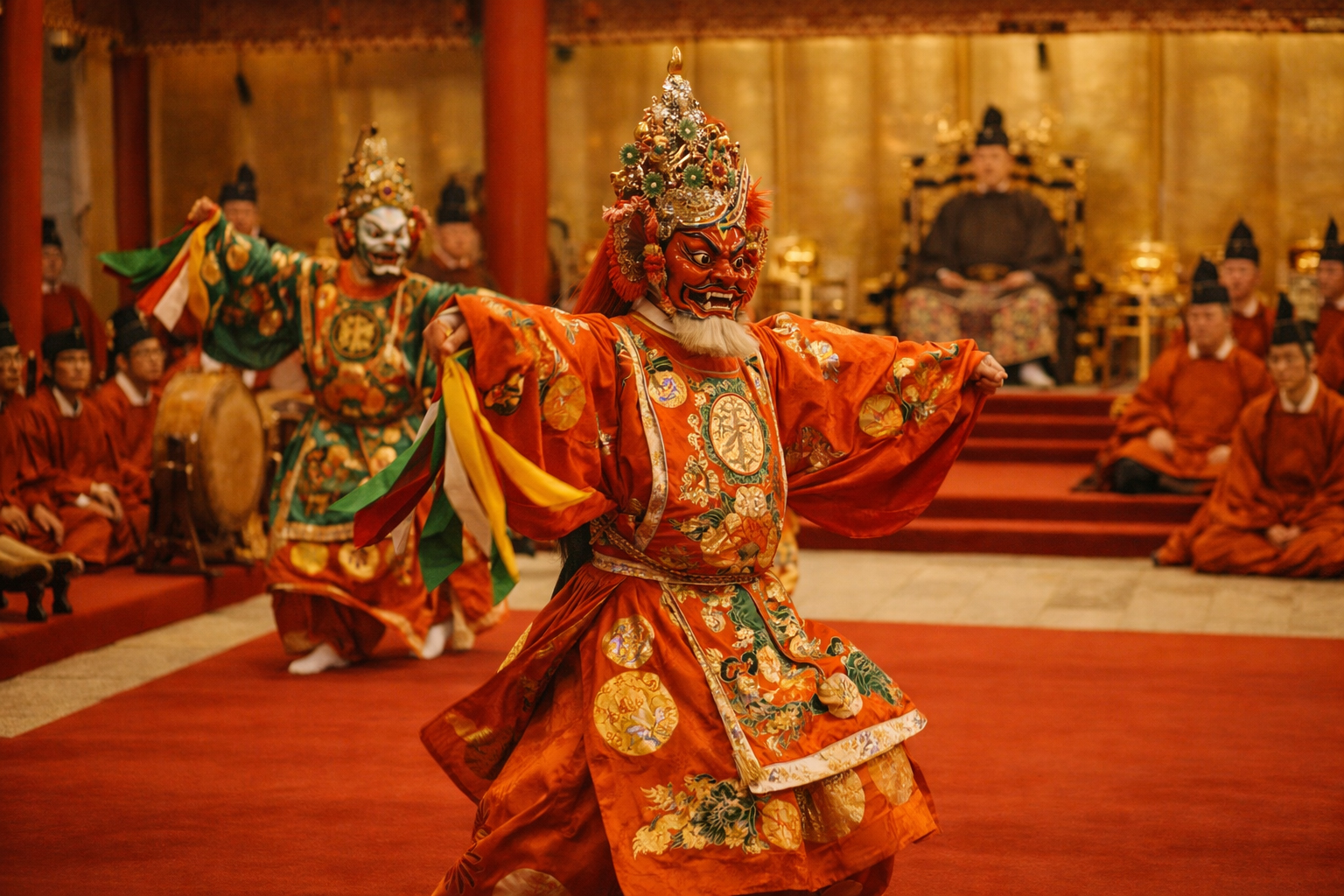
It can be tempting to treat sacred and court dance as simply “before” later folk and communal dance. But the history is better understood as branching rather than perfectly linear. Sacred dance, court dance, and communal dance overlap and coexist as different roots of Japanese movement culture. This is an inference based on the historical distinctions above. :contentReference[oaicite:23]{index=23}
Ancient dance is therefore not merely old choreography. It is one of the first maps of where Japanese bodies moved toward myth, toward power, and toward collective life.
In ancient Japanese dance live some of the deepest bodily memories of myth, ritual, court order, and communal becoming.
From the floor of a disco or club, ancient Japanese dance can look impossibly distant. Yet at a deeper level, it still belongs to the same long history: bodies placed to sound in order to make another kind of time appear.
That distance is exactly what makes it interesting on clubs.co.jp. Modern freedom on the dance floor stands very far downstream from ancient ritualized movement.
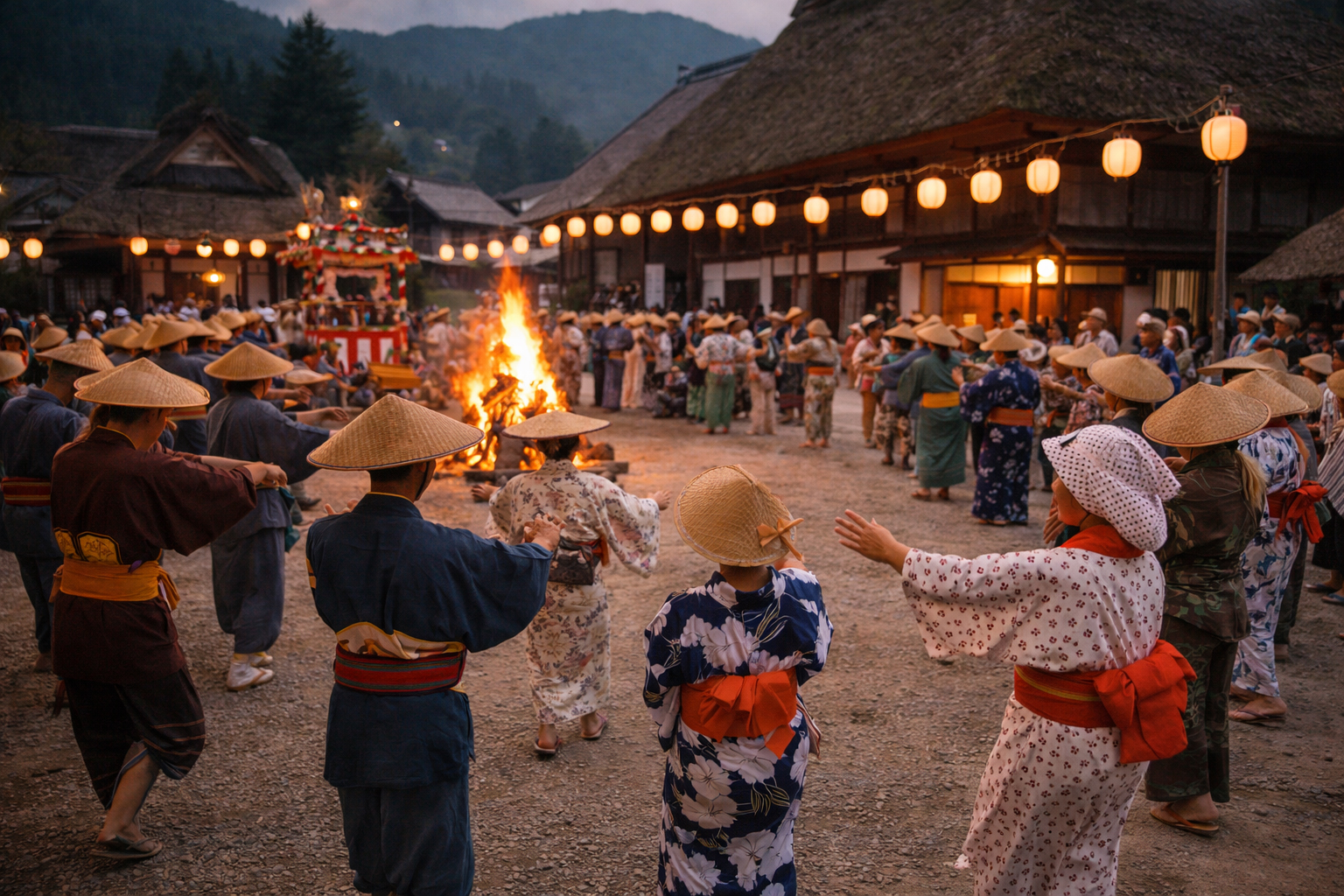
Later folk and communal traditions develop a different bodily logic inside seasonal and village life.
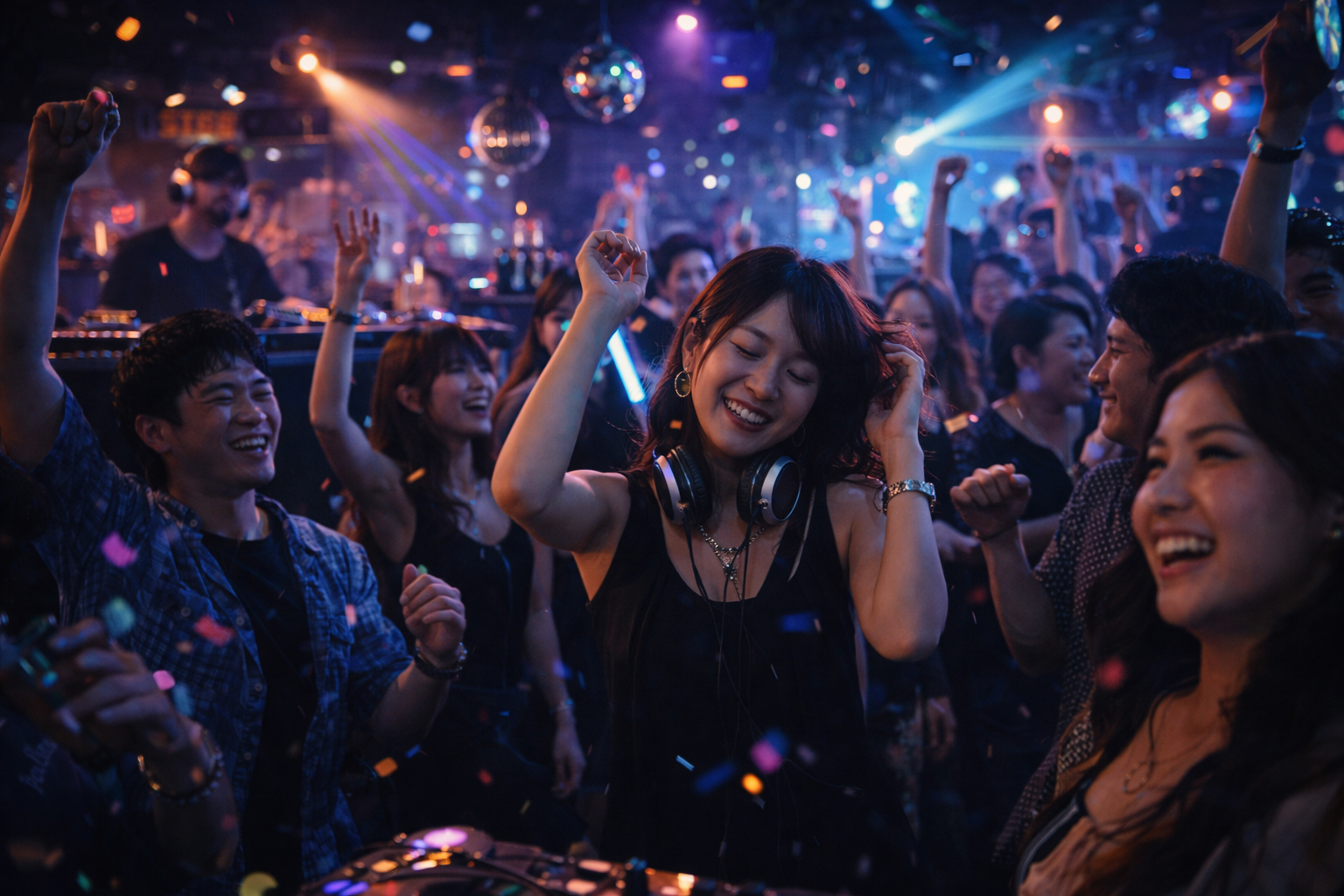
Modern nightlife eventually relocates dance into pleasure, display, and music-centered city life.
Ancient dance in Japan does not explain every later form directly. But if you want the deepest layer of meaningful movement in Japanese history, this is one of the places you must begin. :contentReference[oaicite:24]{index=24}
clubs.co.jp wants to preserve ancient dance not as a distant museum fragment, but as one of the great beginnings of Japanese dance history, where movement first acquired stable mythic and ritual form.
The sacred branch of ancient movement, directed toward shrine ritual and myth.
How ancient dance was refined into durable court ceremony and form.
Move from sacred and courtly roots into communal seasonal dancing.